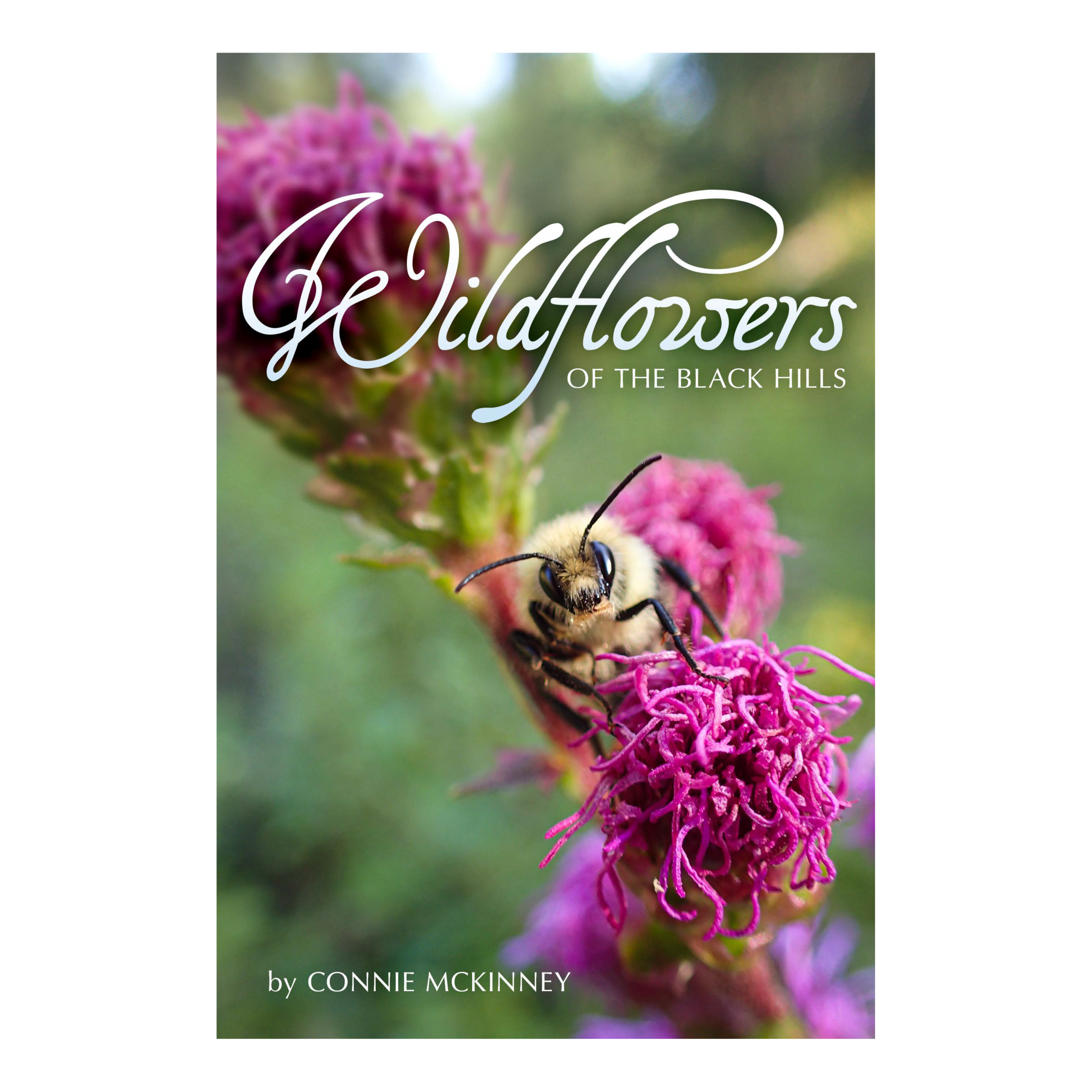
Description
About this guide
Wildflowers of the Black Hills is a regional field guide written and self-published by Connie McKinney in 2021 (ISBN 9780578852447). It covers the wildflowers of the Black Hills, the roughly 1.25 million-acre forested uplift that rises out of the surrounding mixed-grass prairie across western South Dakota and northeastern Wyoming. The Black Hills are one of the more botanically diverse regions in the central United States: the region’s flora includes around 1,500 vascular plant species, drawing on prairie species from the surrounding plains, montane species more typical of the Rocky Mountains to the west, and a small set of true endemics that grow nowhere else.
The guide is built for use, not for keying out. Entries are organized first by flower color, then within each color section by bloom season. If a flower is in front of you and you can see what color it is, you can find it. The author keeps technical botanical terminology to a minimum so the book is genuinely useful to someone with no formal training in botany. The spiral binding lies flat on a trailhead bench or a knee, and the trim size fits a daypack side pocket.
What’s inside
- Full-color field photographs of Black Hills wildflowers in their natural habitat
- Color-first organization (white, yellow, pink, red, blue, etc.) with bloom-season ordering inside each color
- Common names and scientific (genus and species) names for each entry
- Brief identification notes per species
- Coverage spanning the full Black Hills habitat range: ponderosa pine forest, mixed-grass prairie, riparian draws, rocky outcrops, and the higher-elevation country around Black Elk Peak
- Spiral-bound construction so the book lies flat on a bench, a tailgate, or a knee while you compare a photograph to the plant in front of you
The Black Hills as wildflower country
The Black Hills are an island of forested mountain habitat surrounded by prairie. That ecological setup is the reason the wildflower diversity is what it is. Prairie plants from the surrounding Great Plains push up into the lower elevations. Montane plants more common in the Rocky Mountains hold on at higher elevations and on north-facing slopes. The region’s geology runs from limestone plateaus to granite spires to the surrounding red-rock racetrack of the Hogback. Each substrate carries its own plant community. The result is a flora that includes pasque flower (the South Dakota state flower), prairie smoke, Black-eyed Susan, Rocky Mountain iris, columbine, fringed gentian, and a long list of orchids, lilies, asters, and milkweeds that change through the May-to-September bloom season.
The 1874 Black Hills Expedition, led by George Custer, recorded “a profuse display of flowers” at the time of arrival. Botanists with the expedition collected the first scientific specimens of many Black Hills species. The flora the book documents is in the same lineage as that 19th-century collection, updated to current taxonomy.
Where to use this guide
The book covers the Black Hills region as a whole. Useful at:
- Wind Cave National Park (mixed-grass prairie and ponderosa pine country south of Custer, where pasque flower and prairie smoke are common in spring)
- Jewel Cave National Monument (above-ground ponderosa pine forest along US-16 between Custer and Newcastle)
- Black Hills National Forest trails (Black Elk Peak, Sylvan Lake, Spearfish Canyon, Pactola, Cathedral Spires, the Centennial Trail)
- Custer State Park and the surrounding state-park system
- Any private or public land in the Black Hills uplift, the surrounding Hogback, or the prairie-foothill transition
Wildflowers in NPS units may not be picked, dug, or removed. Black Hills National Forest follows USFS rules for plant collection. Leave the wildflowers where they grow; the photograph and the field-guide entry are the souvenir.
Specifications
- ISBN-13: 9780578852447
- Author: Connie McKinney
- Publisher: Connie McKinney (self-published)
- Published: 2021
- Binding: Spiral-bound paperback
- Dimensions: 6″ x 9 1/4″ x 1/4″
- Pages: Approximately 89 (pending physical verification)
Who is this for?
Hikers and visitors at Wind Cave National Park, Jewel Cave National Monument, and the Black Hills National Forest who want to put a name to what is blooming next to the trail. The color-first organization means you do not need to know the difference between an Asteraceae and a Brassicaceae to use it. Pasque flower in April, prairie smoke in May, columbine in June, fringed gentian in late summer: all findable in the section that matches the color you are looking at.
Visitors driving the Black Hills loop (Mount Rushmore, Crazy Horse, Custer State Park, Spearfish Canyon, Deadwood) who want a single regional reference instead of a continental field guide that covers everything from Florida to Alaska. A regional book gives you better coverage of the species you are actually going to see.
Local residents, master naturalists, and trail volunteers in the Black Hills who want a current field reference. The book is written from inside the region, not assembled from a national publisher’s desk.
Gift buyers looking for a Black Hills keepsake under $20 that is more useful than a fridge magnet. This is the kind of book a recipient actually keeps in the glovebox or daypack rather than on a shelf.
Frequently asked questions
How is the book organized?
By flower color first, then by bloom season inside each color. White flowers in one section ordered earliest-blooming to latest, then yellow flowers in the same way, and so on. The author notes that many flowers show a wide range of color variation, so if a plant is not where you expect it, check the next-most-similar color section.
Is this for a beginner or for someone who already knows their botany?
Beginner-friendly. The author explicitly limits technical botanical terminology and organizes the book by flower color first so anyone who can see a yellow flower can find it in the yellow section. Readers who want to move into more technical work (using formal plant keys) can use this guide as a regional reference and then turn to a more technical source like Flora of the Great Plains.
How does this compare to Van Bruggen’s “Wildflowers of the Northern Plains and Black Hills”?
Van Bruggen’s book is the longstanding 1976 reference (ISBN 9780912410043) for the broader northern plains region. McKinney’s guide is newer (2021), is focused tightly on the Black Hills rather than the broader plains, uses full-color field photographs throughout, and is spiral-bound for in-the-field use. They are complementary references, not direct replacements for one another.
Does this guide cover Custer State Park, Mount Rushmore, and the Crazy Horse area?
Yes for the wildflowers. The book is organized around the Black Hills region rather than around any one park boundary, so the species you will see at Custer State Park, Mount Rushmore National Memorial, the Crazy Horse Memorial grounds, and the surrounding Black Hills National Forest are documented in the same single book. (Mount Rushmore and Custer State Park are not BHPFA partner sites, which is why the “proceeds support” line below names Wind Cave, Jewel Cave, and the Black Hills NF instead.)
Is there a companion volume for the Wildcat Hills in western Nebraska?
Yes. The same author published Wildflowers of the Wildcat Hills (ISBN 9780578852454, also 2021), which covers the rocky escarpment along the south side of the North Platte River that includes Scotts Bluff National Monument. It is sold separately and works the same way (color-first, spiral-bound, beginner-friendly).
Why spiral-bound instead of a regular paperback?
Spiral binding lies flat. When you are sitting on a trailhead bench or a tailgate trying to compare a photograph in the book to a flower you are holding next to it, a flat-lying book is meaningfully easier to use than a paperback that wants to flop closed. The trade-off is that the spiral-bound spine takes up a little more pack-pocket space than a paperback of the same page count.
Where can I use this guide?
Anywhere in the Black Hills uplift across western South Dakota and northeastern Wyoming. The book is written for the regional flora, not for one park, so it works on trails inside Wind Cave National Park, Jewel Cave National Monument, the Black Hills National Forest, Custer State Park, and on private and other public land throughout the region.
Does buying this book support national parks?
Yes. BHPFA is the official nonprofit partner of Wind Cave National Park, Jewel Cave National Monument, Scotts Bluff National Monument, and Agate Fossil Beds National Monument, as well as the Black Hills National Forest and Nebraska National Forests & Grasslands. Proceeds from every purchase support education programs, conservation projects, and visitor services at these sites.