Skip to content

Plan your visit

Jewel Cave National Monument, the Underground Treasure

Jewel Cave National Monument • Custer, South Dakota

Jewel Cave National Monument: the underground treasure of the Black Hills

Under a few square miles of ponderosa forest west of Custer lies the fifth longest cave in the world, its walls glittering with calcite, and by every measure of the cave’s own breathing, most of it is still waiting to be found.

Where
Black Hills, SD
13 mi west of Custer
Established
1908
first cave national monument
Mapped
220+ mi
fifth longest in the world
Cave temp
49°F
year-round, bring a layer
Entrance fee
Free
cave tours ticketed
Managed by
NPS
BHPFA partner
Summer cave tours regularly sell out. Tours for May through November open on recreation.gov about 30 to 60 days ahead, and tour tickets are cashless (credit or debit only). Here is exactly how to reserve.

Drive the pine hills west of Custer and nothing on the surface gives it away. A modest visitor center, two hiking trails, a canyon or two. Then an elevator door opens 200-some feet down, and you are standing inside the fifth longest cave in the world: more than 220 miles of mapped passages stacked in a three-dimensional maze, walls lined with calcite crystal that glints wherever light lands.

The name is honest. When two prospectors squeezed through a whistling opening in Hell Canyon in 1900, their candlelight caught walls that glittered like gems, and they staked a mining claim on the “jewels.” The crystals turned out to be worth far more left in place. Within a decade the cave was a national monument, and more than a century later its explorers are still nowhere near the end of it.

Every trip underground here is a ranger-guided tour, from a 20-minute chamber visit by elevator to a crawl that takes most of an afternoon, so a good visit starts with picking the right tour and booking it early. This page is your way into the whole story: how the cave formed, who found it, why the map keeps growing, and how to plan a day here. The three short guides below handle the tour logistics.

What is Jewel Cave National Monument?

Jewel Cave National Monument protects one of the longest cave systems on Earth, in the southwestern corner of South Dakota’s Black Hills along US Highway 16, about 13 miles west of the town of Custer and 50 miles southwest of Rapid City. Above ground it is a small park: a visitor center, two trails, ponderosa forest, and canyon country. Underground it is enormous, and the mapped part is thought to be a small fraction of the whole.

The cave is open only by guided tour, which is what keeps it pristine, and there is no entrance fee for the monument or the visitor center. You pay only for the tour you take. That combination, a world-ranking cave with a free front door, makes Jewel Cave one of the best half-day stops in the Black Hills, and one of the most commonly skipped. The travelers who do stop tend to tell each other not to make that mistake.

Who discovered Jewel Cave?

In the summer of 1900, two local prospectors, brothers Frank and Albert Michaud, noticed something strange while looking for mining prospects in Hell Canyon: wind whistling out of a small natural opening in the rock. They enlarged the hole, climbed in, and found walls glittering with calcite crystals that looked like jewels by candlelight. They did what prospectors do and filed a mining claim.

The crystals proved unprofitable to mine, so the brothers pivoted to something new for the Black Hills: guided cave tours, among the first in the region. The cave’s beauty and scientific value drew national attention, and in 1908 President Theodore Roosevelt proclaimed Jewel Cave a national monument under the Antiquities Act, the first cave in the United States protected that way.

The U.S. Forest Service managed the monument at first, handing it to the National Park Service in 1933. During the Great Depression, Civilian Conservation Corps crews built a ranger cabin, improved the trails, and set a stone stairway into the cave, groundwork that still shapes how visitors experience the historic entrance today.

Why do the walls glitter?

Jewel Cave was not carved by a rushing river. It was dissolved, slowly, by acid-rich groundwater working through the Pahasapa Limestone, rock laid down under a shallow sea about 350 million years ago. When the Black Hills uplifted around 60 million years ago and the water table eventually dropped, what remained was an intricate three-dimensional maze of chambers and passages.

The cave’s namesake crystals came later, as calcite lining many of the walls: blunt “nailhead spar” and pointed “dogtooth spar” that glint under light. In places the crystals coat entire rooms, the glittering spectacle that stopped the Michaud brothers in 1900. Beyond the jewels, the cave holds a remarkable range of formations:

  • Flowstone cascades that look like frozen waterfalls
  • Stalactites and stalagmites reaching from ceiling and floor
  • Soda straws, delicate hollow mineral tubes
  • Popcorn and frostwork patterning the walls
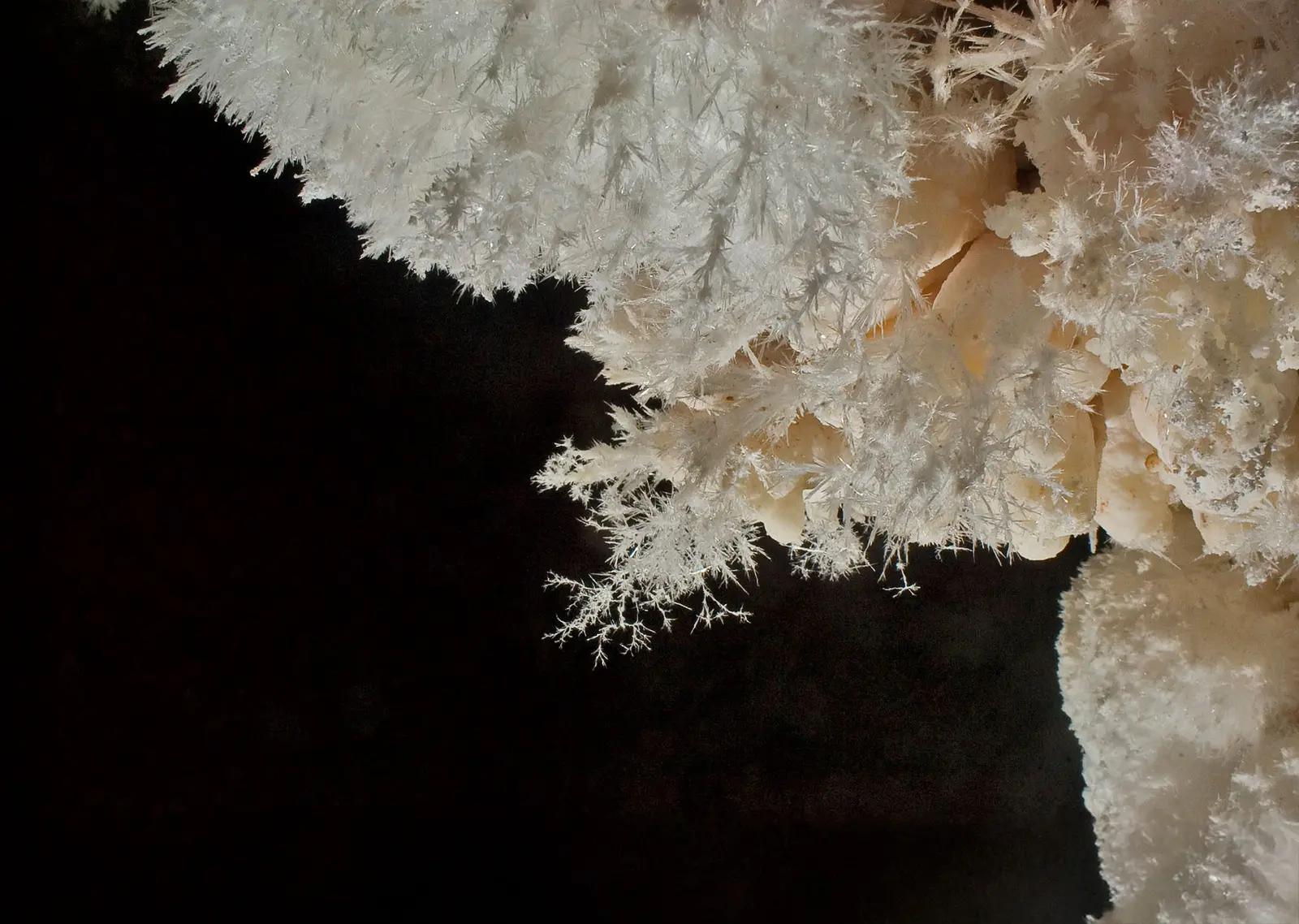
  • Translucent draperies, including the ribbon of streaked calcite nicknamed “Cave Bacon,” more than 10 feet long, the formation in the photo at the top of this page

Drier sections hold rarer features: gypsum “needles” and cottony masses of hydromagnesite. Look closely at the limestone and you can even spot fossil brachiopod shells, relics of the sea that covered this ground 350 million years ago.

Life in the dark

The cave is an ecosystem, not just a gallery. Nine species of bats use Jewel Cave, which shelters one of the region’s largest winter hibernation sites for Townsend’s big-eared bats and the threatened northern long-eared bat. Specialized insects and micro-organisms live in the constant 49-degree air, and isolated pools support cave-adapted amphipods. Life finds its niches, even in total darkness.

How big is Jewel Cave, really?

Bigger than anyone can say. The mapped figure stood at 220.33 miles as of September 7, 2024, which ranks Jewel Cave fifth longest in the world. But the cave breathes: air rushes in and out of its entrances as surface pressure changes, and studies of that airflow suggest explorers have found only about 3 to 5 percent of what is down there.

That means the map is not a finished document. It is a frontier that volunteer cavers push outward on multi-day expeditions, one surveyed foot at a time, and it has been growing for more than a century. The story of how the survey crossed its 200th mile, and what it takes to camp underground to keep exploring, gets its own page: the Jewel Cave 200-mile milestone.

Which cave tour should you take?

Choose the route everyone in your group can manage. The Discovery Tour is the shortest visit; the other routes require stairs or crawling. Check the live schedule before choosing a date.

TourTime and effortTicket pricesBooking
Discovery 20 minutes; elevator to one chamber; 15 steps to the lower platform or a step-free upper platform $6 ages 16 to 61; $3 ages 6 to 15 and 62+; free ages 5 and under Recreation.gov
Scenic 1 hour 20 minutes; 734 stairs; moderately strenuous $16 ages 16+; $8 ages 6 to 15; free ages 5 and under Recreation.gov
Historic Lantern 1 hour 45 minutes; about 600 steep, narrow stairs; summer $16 ages 16+; $8 ages 8 to 15; minimum age 8 Recreation.gov
Wild Caving 3 to 4 hours; extremely strenuous crawling; summer $45; minimum age 16 Separate reservation request

Discovery enters and exits by elevator. Visitors take 15 steps down to the lower platform or stay on the step-free upper concrete platform, which extends 37 feet. NPS recommends this tour for young children, limited time, or health concerns. Scenic follows a paved, lit, half-mile route. Historic Lantern uses the undeveloped historic entrance. Wild Caving requires a fit test through an 8.5 by 24 inch opening.

Discovery access details checked October 17, 2026 against the NPS tour description. Call the park to discuss the route your group needs.

Book Jewel Cave tours at Recreation.gov or read how to reserve a cave tour. Advance reservations are recommended; same-day tickets are not guaranteed. NPS lists a $1 per-ticket Recreation.gov processing fee. Check current NPS fees and ticket conditions before paying. Call 605-673-8300 for access questions.

The fine print that saves trips: reserve ahead on recreation.gov, since summer tours sell out. Tours for May through November open about 30 to 60 days ahead, and the winter season opens as one block at the beginning of December. Booking closes at noon the day before a tour, and closes earlier if that tour sells out. Tickets are cashless, all sales are final, and you should arrive 30 minutes early. Backpacks and hiking sticks stay on the surface, and children may not be carried on tours, with one exception for infants in a front carrier on the Scenic Tour. For the full comparison across both Black Hills caves, see which cave tour is right for you and what to expect underground.

What is there to do above ground?

Start at the visitor center, the gateway to the cave and fully accessible: interpretive exhibits, an information desk staffed by rangers and volunteers, the NPS Passport stamp, and the park store BHPFA runs for the monument. It is open year-round. Here is the full schedule.

Visitor center hours

  • Summer, May 25 through September 7, 2026: open daily, 8:00 am to 5:30 pm Mountain Time.
  • September 8, 2026 through spring: Tuesday through Saturday, 8:30 am to 4:30 pm. Closed Sundays and Mondays.
  • Holiday closures: Thanksgiving (November 26, 2026), Christmas Day (December 25, 2026), and New Year’s Day (January 1, 2027).

The main entrance gate closes promptly at 5:30 pm, so plan your hike or your time on the surface trails to be back out before then. Cave tour times run on their own seasonal schedule and are listed above.

Hours confirmed against the National Park Service on September 8, 2026. We run the park store inside this visitor center, so if you ever find this out of date, tell us at [email protected] and we will fix it.

Two self-guided trails begin near the visitor center. The Roof Trail is an easy quarter-mile paved loop through the ponderosa pines, with benches and a small hill’s worth of views; a few moderate grades keep it from being classed as wheelchair accessible. The Canyons Trail is the real hike: a 3.5-mile loop through Lithograph Canyon and Hell Canyon, rated easy to moderate, with some steep segments and stairs. It passes the cave’s historic natural entrance and an old ranger cabin, and rewards you with wildflower meadows in summer. Watch for mule deer, wild turkeys, and the bighorn sheep that have been reintroduced to the area. In winter, the park loans snowshoes for the same trails under snow.

How do you plan a visit?

When to come: summer (June through August) brings the most tour options and frequencies, and the most competition for tickets. Spring and fall are quieter with pleasant weather, though some specialty tours stand down. Winter is the stillest season of all, with tours on reduced schedules and the trails to yourself.

What to wear: the cave holds 49 degrees Fahrenheit no matter what the surface is doing, so bring a light jacket or sweater even in July. Wear sturdy, closed-toe shoes with good traction; open sandals are not permitted on most tours. Cameras are welcome underground without flash, and food and drinks other than water stay on the surface.

Where it fits in a Black Hills trip: the town of Custer, 13 miles east, is the nearest base for lodging and meals, with Custer State Park just beyond it. Wind Cave National Park, the other great Black Hills cave and a fellow BHPFA partner site, is reached via US 16 and US 385 through Custer. Check the drive for your travel day and leave room for wildlife delays and each park’s check-in time. The tour-picking guide covers how to pull that off.

Who takes care of Jewel Cave?

The National Park Service manages the monument, and much of its work happens out of sight: monitoring the nine bat species that use the cave and guarding against white-nose syndrome, studying the cave’s climate and water to understand how the surface affects the underground, switching to LED lighting that discourages algae from growing on formations, and keeping tour groups small and on designated paths. You help simply by following ranger instructions and never touching the formations; the oils on human skin damage them.

Black Hills Parks & Forests Association is the monument’s nonprofit cooperating association. BHPFA runs the park store at the visitor center and the Jewel Cave collection online, and puts the money back into the place, funding research, interpretation, and education programs at the monument. Buying a book after your tour or becoming a member is a small act with a direct, local return.

Common questions about visiting Jewel Cave

How much does it cost to visit Jewel Cave National Monument?
There is no entrance fee for the monument or the visitor center; you pay only for cave tours. The Discovery Tour is $6 for adults and $3 for youth and seniors. The Scenic Tour is $16 for adults (16 and up) and $8 for youth 6 to 15, with no senior rate. The Historic Lantern Tour is $16 for adults and $8 for ages 8 to 15. The Wild Caving Tour is $45. Tour tickets are cashless, and America the Beautiful passes do not cover tour fees.
Do I need to reserve Jewel Cave tours in advance?
In summer, yes; tours regularly sell out. Reserve on recreation.gov, where tours for May through November open about 30 to 60 days ahead and the winter season opens as one block at the beginning of December. Booking closes at noon the day before a tour, and closes earlier if that tour sells out. The Wild Caving Tour uses a separate Reservation Request Form that closes one week before the tour. All sales are final, and you should arrive 30 minutes early. The reservation guide walks through it step by step.
How hard is the Scenic Tour?
The Scenic Tour is rated moderately strenuous: 1 hour 20 minutes on a paved, lit, half-mile loop with 734 stairs. An elevator takes you into and out of the cave, so the stairs come in stretches rather than one long climb.
What are the Jewel Cave visitor center hours?
From May 25 through September 7, 2026 the visitor center is open daily, 8:00 am to 5:30 pm Mountain Time. From September 8 it runs Tuesday through Saturday, 8:30 am to 4:30 pm, and is closed Sundays and Mondays. It also closes on Thanksgiving, Christmas Day, and New Year’s Day. The main entrance gate closes promptly at 5:30 pm.
What is the Historic Lantern Tour like?
It is a summer-only trip back to the cave’s early days, running through August 28 in 2026: 1 hour 45 minutes by lantern light with a guide dressed in a 1930s-era Park Service uniform, entering through the historic entrance. Expect about 600 steep, narrow stairs and unimproved footing. Tours meet at the Historic Area about a mile west of the visitor center, groups are capped at 15 people, and the minimum age is 8.
Can kids do the cave tours?
Yes. The Discovery Tour is the park’s recommendation for the littlest visitors and is the only tour that allows strollers. Children may not be carried on tours, with one exception: an infant in a front carrier on the Scenic Tour. The Historic Lantern Tour requires age 8, and the Wild Caving Tour requires age 16, strictly enforced with proof of age.
What should I wear in the cave?
The cave holds 49 degrees Fahrenheit year-round, so bring a light jacket even in July, and wear sturdy closed-toe shoes with good traction. Backpacks and hiking sticks are not allowed in the cave, and food and drinks other than water stay on the surface.
How long is Jewel Cave?
Jewel Cave is the fifth longest cave in the world, with 220.33 miles mapped as of September 7, 2024. Airflow studies suggest that only about 3 to 5 percent of the cave has been discovered, and volunteer explorers add new passage every year.
Is there a Passport stamp at Jewel Cave?
Yes. The monument has an NPS Passport stamp available at the visitor center, alongside the park store.
Is Jewel Cave worth visiting?
Yes. Repeat Black Hills travelers often rate Jewel Cave the more decorated of the region’s two great caves, and it draws smaller crowds than its national-park neighbors. Book the Scenic Tour to see the cave at its best, and if your schedule allows, pair it with Wind Cave for a two-cave day.

Help keep the jewel box open

Black Hills Parks & Forests Association is the cooperating association at Jewel Cave. Shopping the visitor center park store, shopping the parks online, or becoming a member funds the research, interpretation, and Junior Ranger programs that bring the cave to life.

You can also donate or volunteer.

Every purchase supports this place

Shop the park stores

We run the bookstores inside the visitor centers. Field guides, maps, and gear, with proceeds going back into education, interpretation, and visitor services.

Shop the Parks Members save 15% on eligible purchases. Join for $30 a year.

Where we work

Explore the places we support

Explore our partner sites in the Black Hills and western Nebraska. Find visitor information and ideas for your trip.