
Description
About this guide
Birds of the Dakotas is the regional field guide most Wind Cave and Black Hills visitors actually pick up at the visitor center, because it is small enough to carry, organized by what the bird looks like, and limited to species that show up in North or South Dakota. Stan Tekiela has written more than 20 of these state-specific guides for Adventure Publications. The 2nd edition (2021) adds six species, updates the photographs, and revises every range map to reflect more recent observation data.
The book uses the same color-section organization Tekiela built his series around. See a yellow bird, turn to the yellow section. Compare the photograph, check the size icon, read the range map, and skim Stan’s Notes for the field marks that distinguish near-look-alikes. It is a faster system than taxonomic order if you do not already know the family, and most casual birders do not.
What’s inside
- 131 species accounts covering birds of North and South Dakota, including six added in the 2nd edition
- Full-page color photographs, plus a “compare” inset for species that look similar
- Range maps for every species showing seasonal presence across the two states
- Color-coded section tabs (the foot of each page) so you can flip to a color group with the book closed
- “Stan’s Notes” for every species: nesting, voice, food, behavior, and the field marks Tekiela emphasizes from his own observation
- Quick-reference icons for size, nest type, migration status, and feeder use
Specifications
- Pages: 344
- Dimensions: 6″ x 4.38″ x 0.56″
- Weight: 10.5 oz
- Binding: Paperback
- Publisher: Adventure Publications
- Author: Stan Tekiela
- Edition: 2nd Edition
- ISBN-13: 9781647551926
- ISBN-10: 1647551927
- Published: November 30, 2021
- Series: Bird Identification Guides (Adventure Publications)
Who is this for?
Wind Cave, Jewel Cave, and Black Hills visitors who want a guide tuned to the species they will actually see. A continent-wide field guide makes you scroll past 800 species that do not occur in the Dakotas. This one cuts straight to the 131 that do.
First-time and casual birders who do not know taxonomic order. The color-organized layout means you can flip to “the yellow section” without knowing whether you are looking at a warbler, a finch, or a tanager.
Visitors heading to Scotts Bluff, Agate Fossil Beds, or Nebraska National Forests and Grasslands. The Dakotas guide overlaps closely with the Nebraska panhandle’s bird list and is a usable companion in either region. If you split your trip between South Dakota and the Nebraska panhandle, this guide covers most of what you will see.
How the color system works
Tekiela’s color organization is the reason these guides became the best-selling regional bird series in the US. Each species is filed under the most prominent color on the male bird (or the most distinctive color, for species without strong sexual dimorphism). Tabs on the page edge let you find the color section by feel. Inside the section, species are ordered roughly by size. When you spot a bird, you flip to its color, scan for a size match, then check the range map to confirm the species is plausible where you are. It is not a perfect system, female and juvenile plumages can fall into different sections, but it is dramatically faster for beginners than taxonomic guides.
Frequently asked questions
How is the 2nd edition different from the 1st?
The 2nd edition (November 2021) adds six species, replaces older photographs with updated ones, revises every range map based on more recent observation data, and expands the Stan’s Notes commentary. If you already own the 1st edition and use it primarily as a quick-ID reference, the 2nd edition is a meaningful update mainly for the new species and the corrected ranges.
Does this work for the Black Hills specifically?
Yes. The Black Hills sit inside western South Dakota and the species accounts include the forest, prairie, and riparian birds you will see at Wind Cave, Jewel Cave, and across the Black Hills National Forest. Wild turkey, golden eagle, common nighthawk, mountain bluebird, white-throated swift, and Lewis’s woodpecker are all in the book.
Will it work in Nebraska panhandle parks (Scotts Bluff, Agate Fossil Beds, Nebraska National Forests and Grasslands)?
Mostly yes. The Nebraska panhandle’s bird list overlaps heavily with western South Dakota and the western edge of North Dakota. Most species you will see in those parks are in this guide. A few sandhills and southern-Nebraska specialists are not, so a Nebraska-specific guide (Tekiela has one) is a better match if your trip is mostly in Nebraska.
Who is Stan Tekiela?
Tekiela is a naturalist, wildlife photographer, and author who has written more than 175 nature books. His regional bird guides cover most US states and were the first widely-distributed series organized by color rather than taxonomy. He shoots most of his own photography and writes the species notes from his own field observation.
Is the color organization a problem if I already use eBird?
The book does not match eBird’s taxonomic order, so you cannot flip through it in checklist sequence. For quick field ID it does not matter. For logging, you read the species name off the entry, then enter that name into eBird. If you want a guide organized in eBird’s order, the National Geographic Field Guide to the Birds of North America (also at BHPFA) follows the American Ornithological Society taxonomy.
Are female and juvenile birds covered?
Most species have a separate female photograph when the female differs significantly from the male. Juveniles are described in the notes but are not always pictured. For tricky juvenile or female plumages, a comprehensive continental guide is a better second reference.
Does buying this support national parks?
Yes. BHPFA is the official nonprofit partner of Wind Cave National Park, Jewel Cave National Monument, Scotts Bluff National Monument, and Agate Fossil Beds National Monument, as well as the Black Hills National Forest and Nebraska National Forests and Grasslands. Proceeds from every purchase support education programs, conservation projects, and visitor services at these sites.
Related titles at BHPFA
- National Geographic Field Guide to the Birds of North America, 7th Edition (continental, taxonomic, 1,023 species)
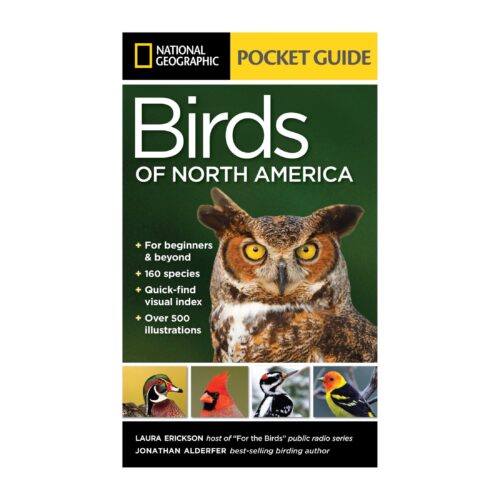
- National Geographic Pocket Guide to the Birds of North America (compact, 160 species, beginner-friendly)