
Black-footed ferret recovery on the Conata Basin
Three decades of partnership on Buffalo Gap National Grassland and Badlands have turned one of America’s rarest mammals into a flagship for endangered species recovery.
In the early morning hours of March 20, 2026, biologists sweep the Conata Basin of Buffalo Gap National Grassland with spotlights, watching for the emerald eye‑flash that signals a black-footed ferret.
Long after the sun slips behind the buttes, narrow beams of light sweep the grasslands—spotlights mounted to pickup trucks, searching for the emerald eyeshine of one of America’s rarest mammals. The mission is part science and part stewardship, carried out under a sky filled with constellations and the quiet of an early spring prairie. The team is here to survey black-footed ferrets: briefly capture them, and collect species-saving samples before returning them safely to the burrows they borrow from prairie dogs.
Once presumed extinct in 1979, black-footed ferrets were rediscovered in 1981 near Meeteetse, Wyoming, after a ranch dog named Shep tangled with what turned out to be a ferret in the Hogg family’s yard. Biologists feared the population was a lost cause—decimated by canine distemper and sylvatic plague—prompting a last-ditch decision to bring the remaining individuals into captivity. Every wild black-footed ferret alive today traces its lineage to those 18 survivors.
By the late 1980s, the Conata Basin of Buffalo Gap National Grassland and the Badlands National Park landscape in South Dakota had emerged as a top reintroduction candidate. After a full environmental analysis and extensive public engagement—sometimes contentious over fears of land use restrictions—ferrets were released into Badlands National Park in 1994–95 and onto Buffalo Gap National Grassland in 1996. As veteran biologist Travis Livieri put it with a smile: “We put ferrets in the park. The world didn’t end.”
If anything, a blueprint for endangered species recovery began.
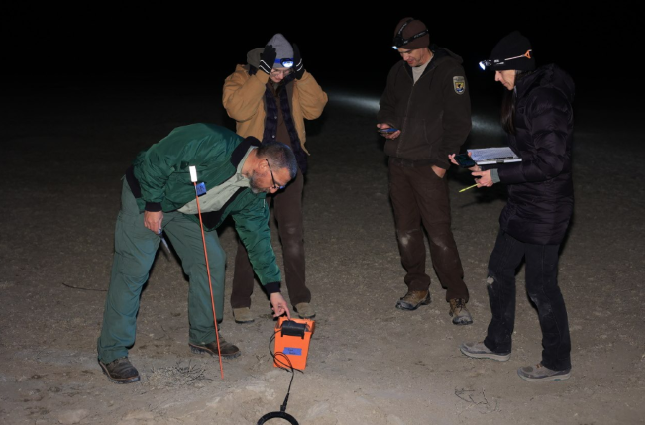
At the Nebraska National Forests & Grasslands, Wildlife Program Manager Phil Dobesh holds a long-term role in this work that has demanded steady hands and steady partnerships.
“We do our best to balance the needs of this species in the safe haven it has here and the needs of our neighbors,” Dobesh said. “We coordinate monitoring and active plague management for Conata Basin’s black-footed ferrets, and we conduct prairie dog control efforts on Buffalo Gap National Grassland to be good neighbors to adjacent landowners. Contractors may treat an area, but we are responsible for the results of that work.”
That balance—habitat conservation in service of biodiversity and working lands—is where the land management’s mission lives.
“I started with the National Park Service, but when I wanted to pivot and launch a nonprofit—so we could be more flexible and creative with funds—the idea was welcomed with open arms,” Livieri said. “The District Ranger in Wall supported it, and I applied to be a seasonal wildlife technician. Half the year I was stewarding habitat as a Forest Service seasonal. The other half, I was building what has become Prairie Wildlife Research.”
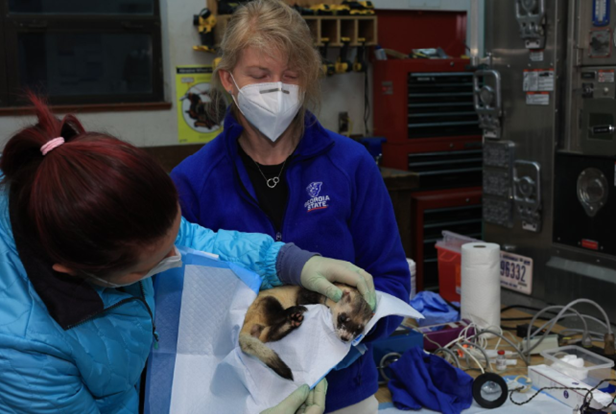
The makeshift lab for biomedical sampling unfolds in the Forest Service’s Wall Ranger District shop. After ferrets are evaluated and samples taken, they spend the next day—their night—resting in the Ranger District wildlife office before being released the following evening.
“Conata Basin–Badlands is the proof of concept. We can breed ferrets in captivity, reintroduce them, manage disease, and sustain fully wild populations. This site has shown that recovery can work.”
Travis Livieri, Prairie Wildlife Research
That success is the product of great partnerships—the U.S. Forest Service, National Park Service, U.S. Fish and Wildlife Service, U.S. Geological Survey, state partners, tribes, universities, zoos, and conservation nonprofits working across boundaries and budgets to care for a single, shared ecosystem. Weekly coordination calls keep the effort moving: who’s trapping where, which colonies need plague management, what data are coming in, and how drought, grass production or weather may shift the next month’s plan.
Work that starts under a spotlight ends with a ferret more enabled to thrive. Each captured animal receives a microchip ID, vaccines against distemper and plague, and noninvasive samples—cheek swabs, hair, occasionally feces for health and diet analysis. In collaboration with Adele Pietras, DVM (Cornell) and Ph.D. student (University of Florida), the team also takes a tiny ear biopsy that quickly heals. Those cells are grown in the lab and biobanked as living cell cultures to study genetics over time.
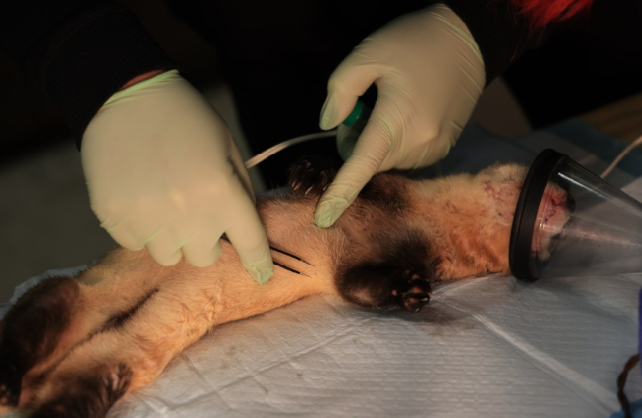
“Think of biobanking like saving seeds. Except with mammals, we preserve live cell cultures. It’s minimally invasive, and it gives future scientists options—from routine genetic analyses to, one day, potentially cloning.”
Adele Pietras, DVM, University of Florida
Conata Basin–Badlands ferrets offer something no other site can claim: 20-plus generations born and raised entirely in the wild. While many reintroduction areas supplement with captive-born animals, this population has not needed reinforcement since the 1990s. Wild life brings wild selection—real burrows, real prey, real predators, real weather—and that environmental pressure helps shape gene expression and fitness in ways cages simply can’t.
“These are probably the most valuable black-footed ferrets on the planet. They’re expressing their genetics where it matters—on the landscape.”
Travis Livieri, Prairie Wildlife Research
This landscape is shared: Prairie dogs are a keystone species, engineering habitat that benefits burrowing owls, swift foxes, mountain plovers and, critically, black-footed ferrets. Bison and cattle grazing are equally foundational livelihoods. When rainfall is generous, grass grows, and cows and prairie dogs coexist with minimal friction. In drought years, grass is scarce, and competition sharpens—along with economic stress on ranching families.
It’s why the Conata Basin–Badlands partnership prioritizes listening and balance. Ranchers know these prairies like few others, and their operations keep rural communities resilient. Conservation teams factor grazing schedules, plague cycles, and grass production into ferret management. Decisions are informed by field science and lived experience. No one wins if working lands fail; no one wins if biodiversity collapses. The goal is both: healthy herds, healthy grass, healthy wildlife.
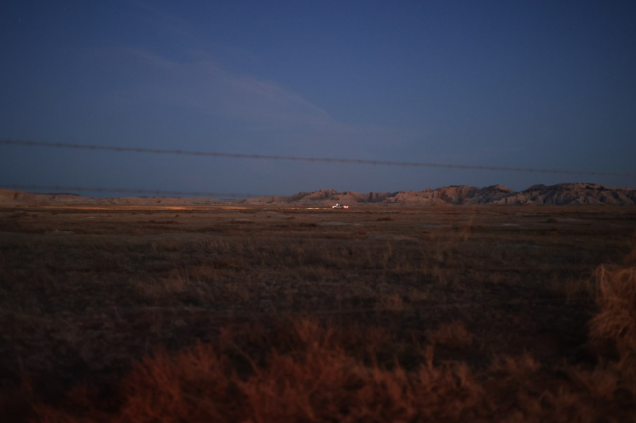
The team’s work reveals just how hard ferrets work to survive. Adults may live only a couple of years in the wild—predators, disease and the demands of hunting take a toll—but when conditions are good, ferrets rebound. They breed once a year, and mothers secure easier meals in June and July, when prairie dog pups are small. By autumn, bold young ferrets disperse across the grasslands, gambling on new colonies and new futures.
Next fall, the team will reconvene for population surveys in October—that precious annual window when kits born the past spring are venturing out but haven’t yet left the area they were born.
“That’s fun, because that’s when we see more numbers—and we get to see the fruits of this work.”
Travis Livieri, Prairie Wildlife Research
Thirty years on, Conata Basin–Badlands remains a flagship for interagency cooperation. Forest Service range specialists and wildlife staff, Park Service biologists, Fish and Wildlife Service recovery teams, USGS researchers, state agencies, tribal biologists, zoos and nonprofits like World Wildlife Fund and Defenders of Wildlife each bring tools the others don’t. The result is a living, breathing demonstration that America’s working lands can support biodiversity—and that biodiversity strengthens those lands in return.
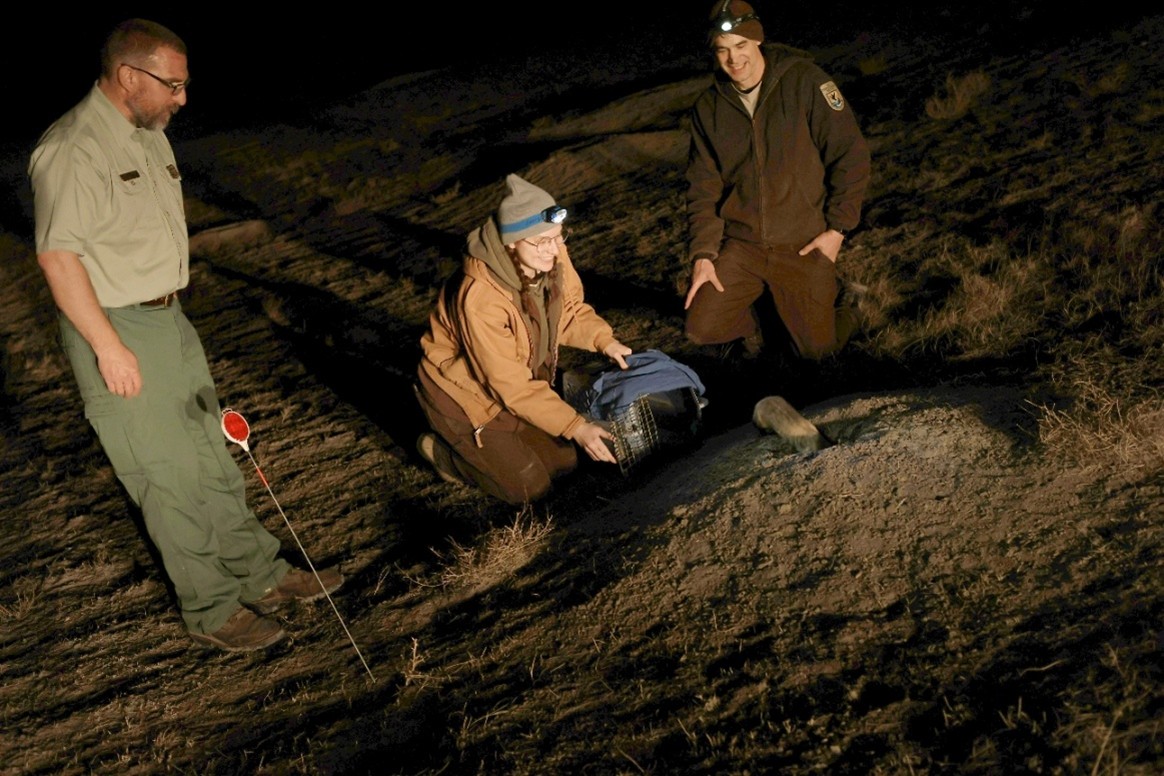
“Sometimes I joke we have an embarrassment of riches,” Livieri said of the half-million-acre footprint shared by Badlands National Park and Buffalo Gap National Grassland. “Some of those riches are the people committed to the ecological health of prairie.”
On a landscape where ranchers raise cattle, prairie dogs dig towns, and black-footed ferrets thread the night between them, partnership is the light that keeps the future in view.
About black-footed ferrets and the Conata Basin
Quick answers for visitors, students, and anyone meeting this recovery story for the first time.
What is a black-footed ferret?
The black-footed ferret (Mustela nigripes) is a native North American mustelid, often called America’s rarest mammal. It was presumed extinct in 1979 and rediscovered in 1981 near Meeteetse, Wyoming.
When were black-footed ferrets reintroduced to South Dakota?
Ferrets were released into Badlands National Park in 1994 and 1995, and onto Buffalo Gap National Grassland in 1996. The Conata Basin–Badlands population has not needed reinforcement from captive-born animals since the 1990s.
What is the Conata Basin?
The Conata Basin is a section of Buffalo Gap National Grassland in southwestern South Dakota, administered by the Nebraska National Forests and Grasslands. Together with neighboring Badlands National Park, it anchors black-footed ferret recovery on a roughly half-million-acre shared landscape.
Why are black-footed ferrets endangered?
Canine distemper and sylvatic plague decimated wild populations in the twentieth century. Every wild black-footed ferret alive today descends from 18 individuals captured for breeding after the 1981 rediscovery.
Why do ferrets need prairie dogs?
Prairie dogs are a keystone species. Black-footed ferrets shelter in their burrows and rely on them as their primary food source. Healthy prairie dog colonies also support burrowing owls, swift foxes, and mountain plovers.
Who manages black-footed ferret recovery in the Conata Basin?
Recovery is led on Buffalo Gap National Grassland by the U.S. Forest Service (Nebraska National Forests and Grasslands), in partnership with the National Park Service, U.S. Fish and Wildlife Service, U.S. Geological Survey, South Dakota Game, Fish and Parks, tribes, universities, zoos, and conservation nonprofits including Prairie Wildlife Research.
Can I see black-footed ferrets in the wild?
Black-footed ferrets are nocturnal and difficult to observe. Population surveys happen on Buffalo Gap National Grassland and in Badlands National Park, usually in fall. Visitors can learn more at the National Grasslands Visitor Center in Wall, South Dakota, where BHPFA operates a bookstore alongside the Forest Service team.
When is Endangered Species Day?
Endangered Species Day falls on the third Friday in May each year. In 2026 it is observed on May 15.
How can I support endangered species work on public lands?
Join BHPFA, shop our bookstore, or donate. Membership and store sales fund interpretation and conservation programs on Wind Cave National Park, Jewel Cave National Monument, Scotts Bluff National Monument, Agate Fossil Beds National Monument, Black Hills National Forest, and Nebraska National Forests and Grasslands.
Nebraska National Forests & Grasslands
Our partner unit that administers Buffalo Gap National Grassland and the Conata Basin.
Park storeField guides & prairie reads
Books, maps, and gifts. Every purchase supports conservation and interpretation on our partner lands.
MembershipJoin BHPFA
Members keep this work funded year-round across all our partner sites.
What’s onEvents calendar
Hikes, talks, and partner-site programs across the Black Hills and grasslands.
Public lands work because partnerships do
Three decades of black-footed ferret recovery were built by agencies, tribes, ranchers, scientists, and nonprofits working the same prairie. BHPFA helps keep that work visible and funded across our partner units. Stop in, shop the store, or join us.